
Educational resource only  ·  Not medical, legal, personal-use, commercial, or use guidance  ·  No commerce on this page  ·  21+ only
Person looking thoughtfully toward the Boston harbor skyline at golden hour, Custom House Tower visible in background
📚 Educational resource · Boston, MA · Veteran-founded 2016

Where American psychedelic research began — and where it is heading

A research-first educational resource for Boston and the Greater Boston metro. Harvard’s legacy. McLean Hospital’s present. Massachusetts legal context. Peer-reviewed findings — presented factually, without commercial framing.

Veteran-founded 2016 Harvard legacy · McLean Hospital Educational only · 21+
1960
Harvard Psilocybin
Project begins
1962
Marsh Chapel
first double-blind study
McLean
Harvard-affiliated
active research site
2021
Cambridge & Somerville
local deprioritization
The Harvard legacy

Where American academic psychedelic research was born — Cambridge, Massachusetts

No American city has a deeper institutional history with academic psychedelic research than Boston. The foundational studies that shaped the modern literature were conducted not in California, not at a government facility — but at Harvard University and Boston University, in Cambridge and the Fenway.

1960
Harvard University, Cambridge
The Harvard Psilocybin Project begins
Timothy Leary and Richard Alpert (later Ram Dass) initiate one of the first formal academic investigations of psilocybin in the United States. Conducted at Harvard University in a supervised research context, the project documented outcomes across multiple published papers. The institutional setting and peer-review framework it established shaped subsequent research design standards.
1961
Concord State Prison, Concord MA
Concord Prison Experiment
Leary, Alpert, and colleagues administer psilocybin to incarcerated subjects in a supervised clinical setting, measuring recidivism outcomes. Controversial in its methodology, but foundational as one of the first institutional attempts to examine psilocybin outcomes in a controlled longitudinal study.
1962
Marsh Chapel, Boston University
The Good Friday Experiment
Walter Pahnke’s double-blind study at Boston University’s Marsh Chapel — formally titled the “Mystical Experience Questionnaire” study — is one of the most cited early studies in the published psychedelic literature. It represents the first double-blind psilocybin study in American academic history. Conducted in a chapel, not a laboratory, it explored subjective research outcomes under controlled conditions.
2020s
McLean Hospital, Belmont — Harvard Medical School affiliate
Active clinical research continues
McLean Hospital is among the most active psychedelic research sites on the East Coast. Published findings from McLean-affiliated researchers appear in peer-reviewed journals examining supervised psilocybin administration, depression, OCD, and neuroplasticity mechanisms. Research is conducted under federally licensed DEA Schedule I research protocols.
“No American institution contributed more to the early academic literature on psilocybin than Harvard University — in Cambridge, Massachusetts.”
Why this matters for Boston

The Greater Boston metro is not simply a city where psychedelic research is being studied. It is the city where American institutional psychedelic research began. That sixty-year continuum — from Harvard’s original project to McLean’s current clinical trials — is unique to Boston in the American research landscape.

Academic context only. All research referenced on this page was conducted in supervised institutional settings under formal research protocols. This page does not provide personal-use, commercial, or medical guidance of any kind.
The neuroscience

What neuroplasticity is — and why Boston researchers are studying it alongside psychedelic compounds

Neuroplasticity is the brain’s capacity to reorganize itself by forming new neural connections. This capacity continues throughout adult life. It is the foundational concept behind learning, behavioral change, and recovery from certain neurological conditions.

A growing body of peer-reviewed literature — published in journals including Neuron, JAMA Psychiatry, and Pharmacological Reviews — has examined whether and how certain psychedelic compounds interact with neuroplastic mechanisms. Boston-area institutions including McLean Hospital, MGH, and Harvard Medical School are active contributors to this literature.

This page presents the published findings neutrally, without clinical claims or personal-use guidance, for a community with exceptional depth of access to the primary research.

Research context. All findings cited on this page were observed in supervised laboratory or clinical settings. They describe what researchers documented under controlled conditions. Nothing here constitutes personal guidance.
Mechanisms under investigation

What Boston-area researchers are examining

🧠
Synaptic plasticityStrengthening or weakening of neural connections based on activity — the mechanism underlying learning and memory consolidation
🌳
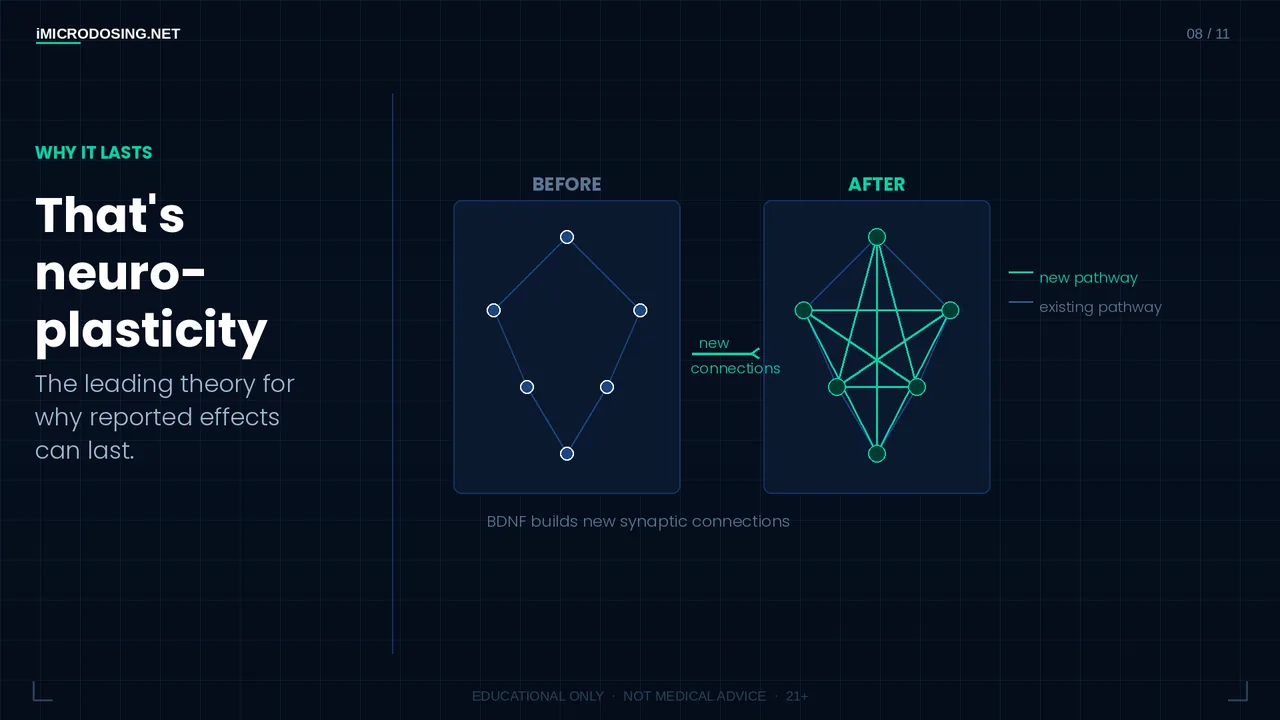
BDNF expressionBrain-Derived Neurotrophic Factor supports neuron survival, growth, and connection formation. Elevated BDNF levels are documented in published psilocybin research.
🌐
Dendritic spine densityPhysical contact points between neurons. Structural changes observed in Yale’s 2021 Neuron study within 24 hours of administration in a controlled preclinical setting.
🔄
Default Mode Network modulationA brain network associated with self-referential thought and rumination. Reduced activity measured in multiple controlled clinical studies.
Published theoretical framework

The REBUS model: how researchers explain what psychedelic compounds do in the brain

REBUS — Relaxed Beliefs Under Psychedelics — published by Carhart-Harris and Friston in Pharmacological Reviews (2019). One of the most cited theoretical frameworks in the modern psychedelic research literature.

🗃
The brain as a prediction engine
Modern neuroscience describes the brain as generating top-down predictions and updating them against sensory input. These predictive structures can become rigid over time — a pattern the published literature associates with certain mood and anxiety conditions.
🔓
The REBUS hypothesis
Carhart-Harris and Friston proposed that psychedelic compounds temporarily reduce top-down predictive signal dominance. The theoretical result: more flexible information processing and increased neuroplastic capacity.
📊
Default Mode Network suppression
Multiple controlled studies, including those conducted at Boston-area institutions, have measured reduced Default Mode Network activity under psilocybin. The DMN governs self-referential thought and rumination.
🏛
Boston’s role in this research
McLean Hospital, Harvard Medical School, and Massachusetts General Hospital are among the institutions that have contributed to the published literature on Default Mode Network modulation and psychedelic compounds.
Theoretical framework only. REBUS is a scientific hypothesis published in a peer-reviewed journal. Not a clinical guideline, treatment protocol, or recommendation.
Episode 2 — Documentary explainer

Your brain on a studied compound: what the published mechanism actually describes

A plain-English documentary explainer — 11 scenes, approximately 3 minutes. How psilocybin interacts with the brain at the molecular level, as described in peer-reviewed published literature.

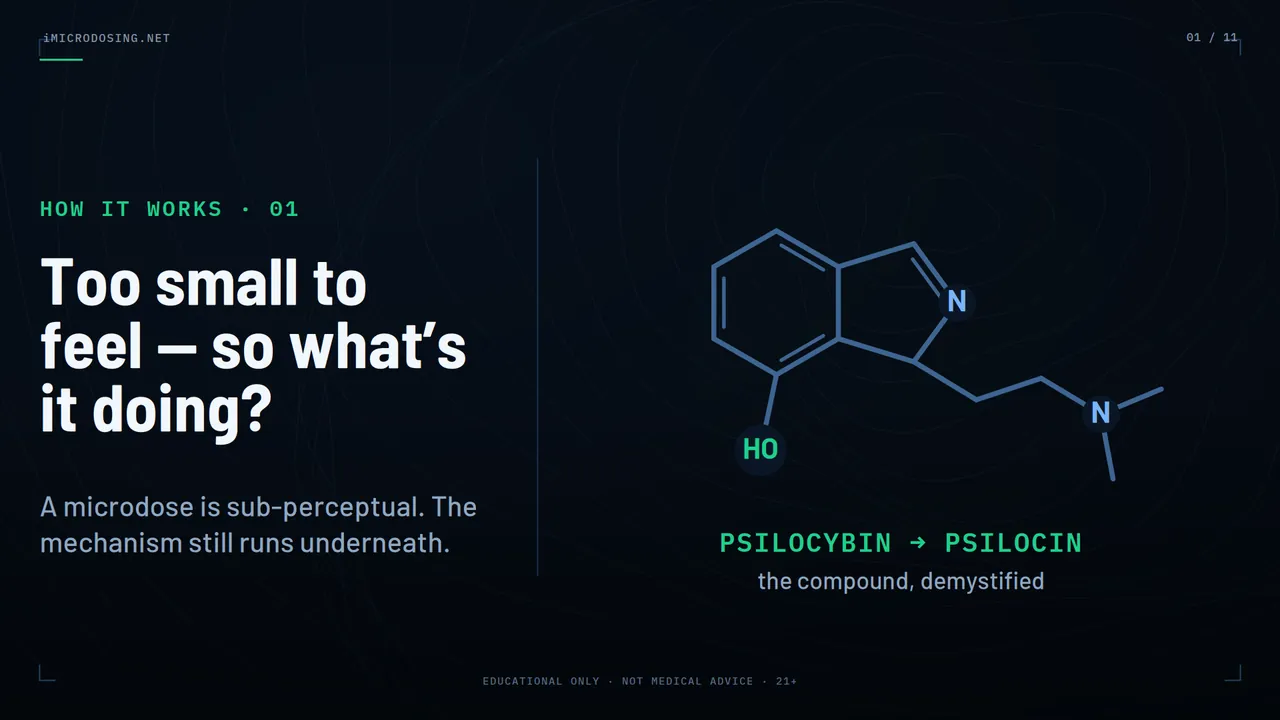
Episode 2, scene 01: Too small to detect — so what is it doing? SCENE 01
Too small to detect — so what is it doing?

Researchers examining this compound describe a fundamental question in the literature: a quantity too small to produce perceptible effects — what is it actually doing inside the body?
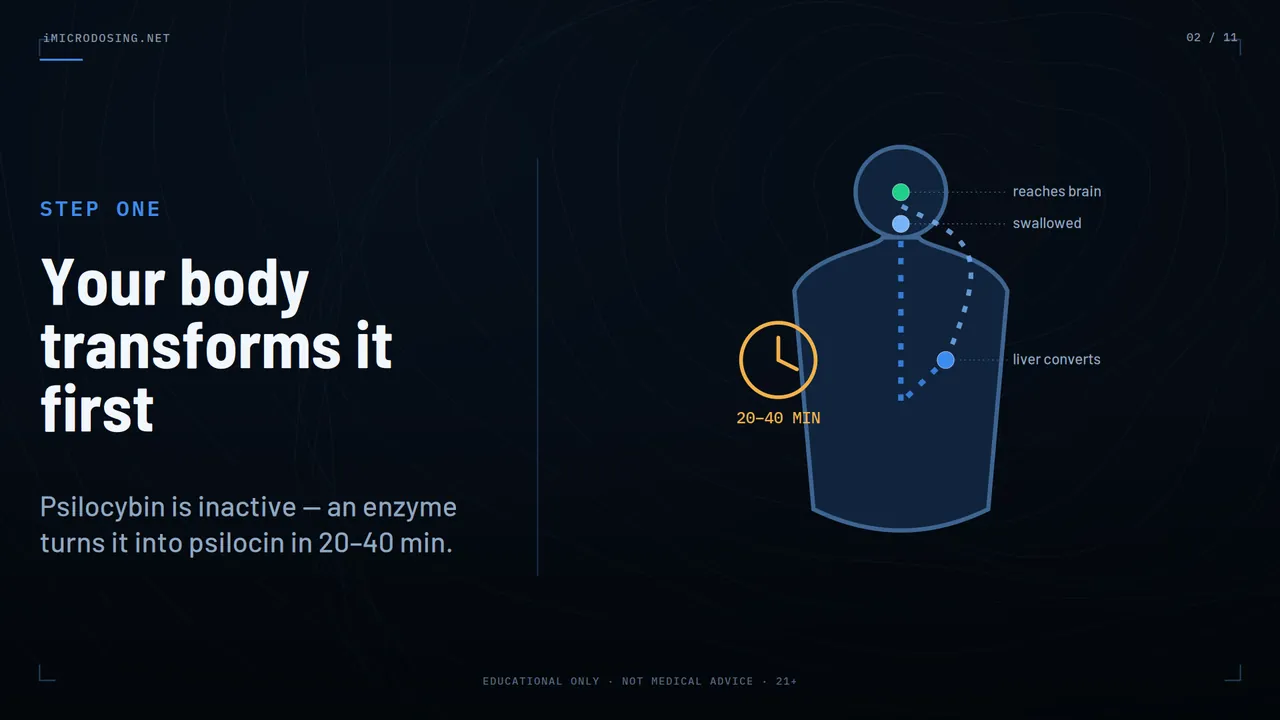
Episode 2, scene 02: The body transforms the compound first SCENE 02
The body transforms the compound first

Published research documents that psilocybin itself is biologically inactive. An enzyme converts it into psilocin — the active form — a process documented across peer-reviewed pharmacology literature.
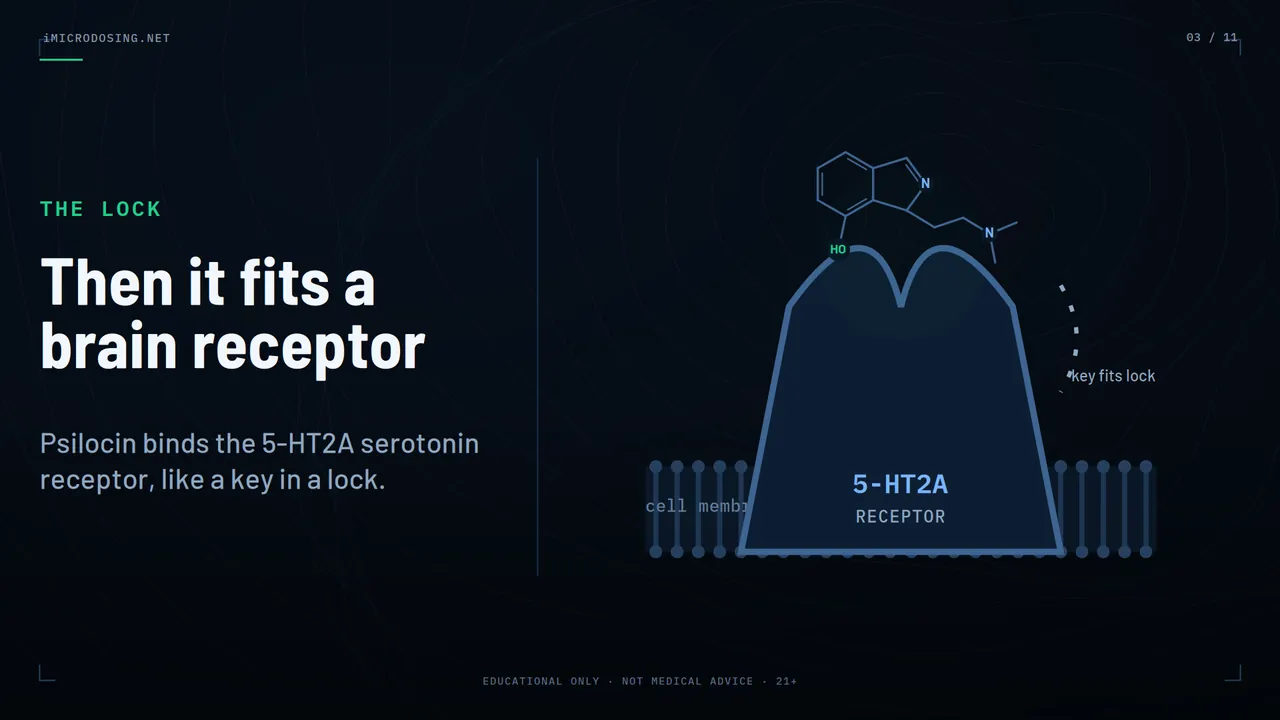
Episode 2, scene 03: Psilocin binds a specific serotonin receptor SCENE 03
Psilocin binds a specific serotonin receptor

Psilocin, the active metabolite, binds preferentially to the 5-HT2A serotonin receptor — a molecular interaction documented extensively in published neuroscience research.
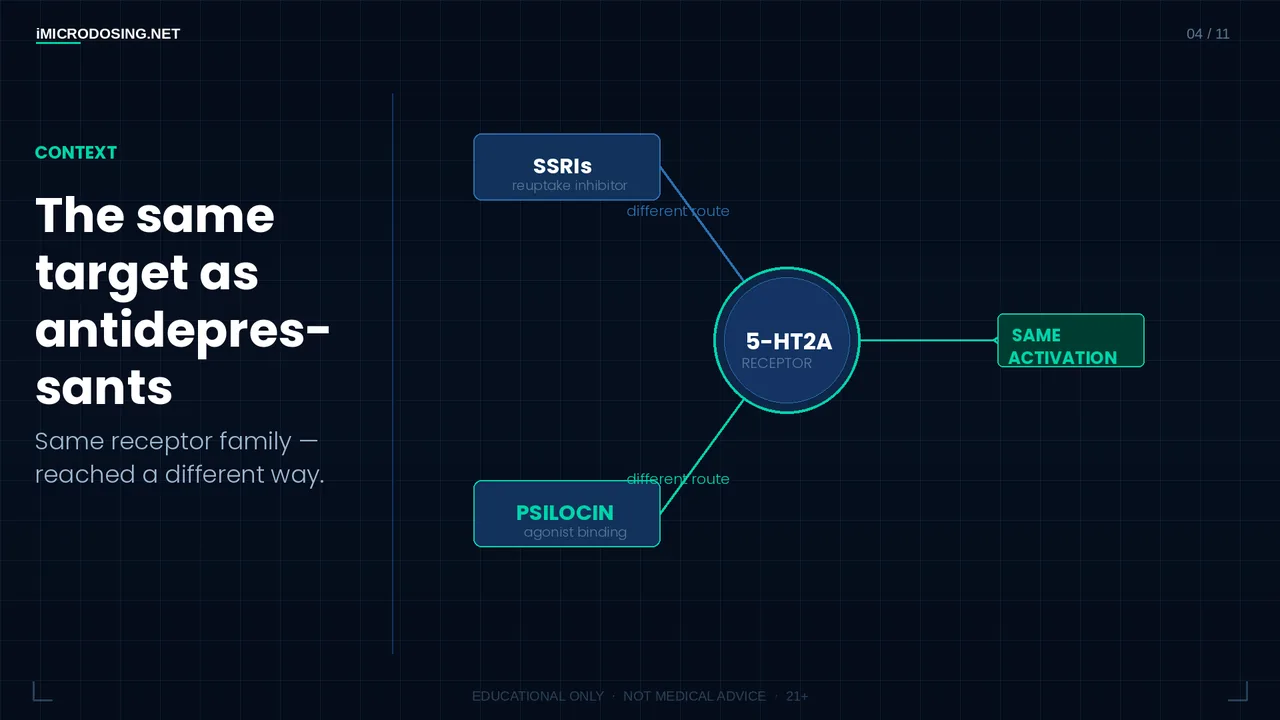
Episode 2, scene 04: The same receptor family as mood-related medications SCENE 04
The same receptor family as mood-related medications

Published research notes that 5-HT2A is the same receptor family targeted by many mood-related pharmaceutical agents, though reached by a different molecular pathway.
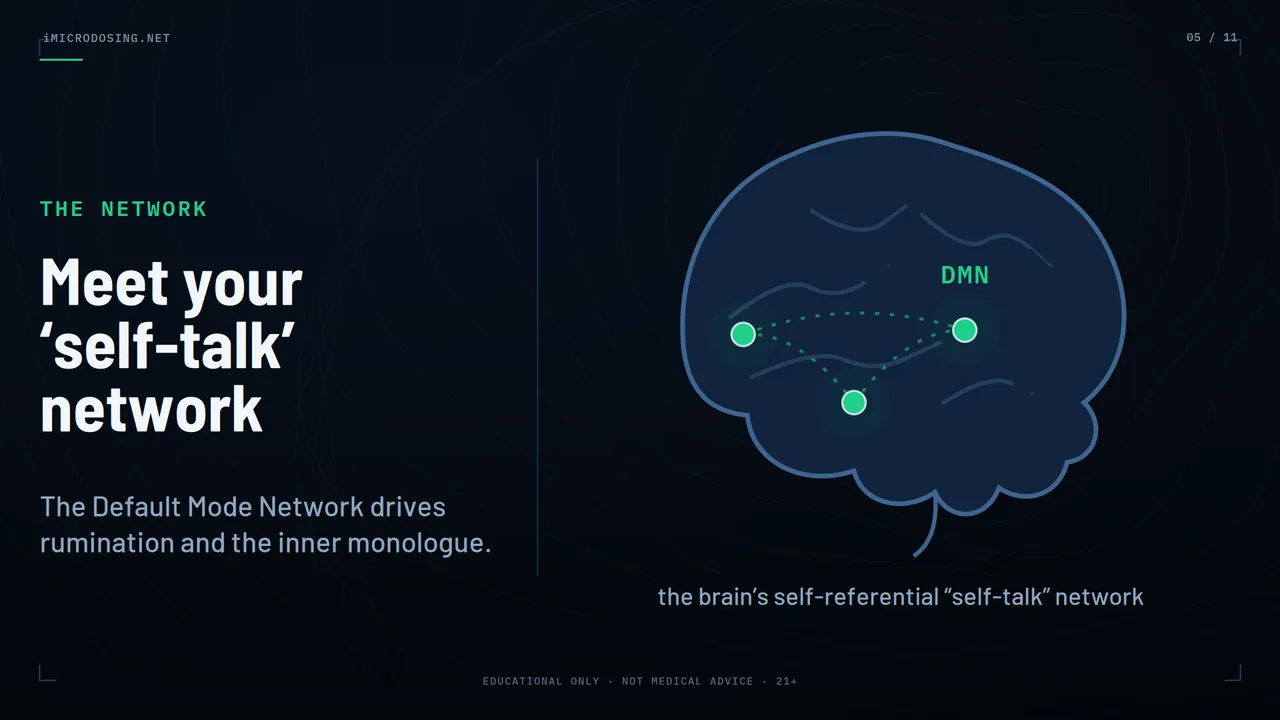
Episode 2, scene 05: The Default Mode Network — your 'inner monologue' system SCENE 05
The Default Mode Network — your 'inner monologue' system

5-HT2A receptors are concentrated on the brain's Default Mode Network — the system researchers associate with self-referential thought, rumination, and the internal monologue.
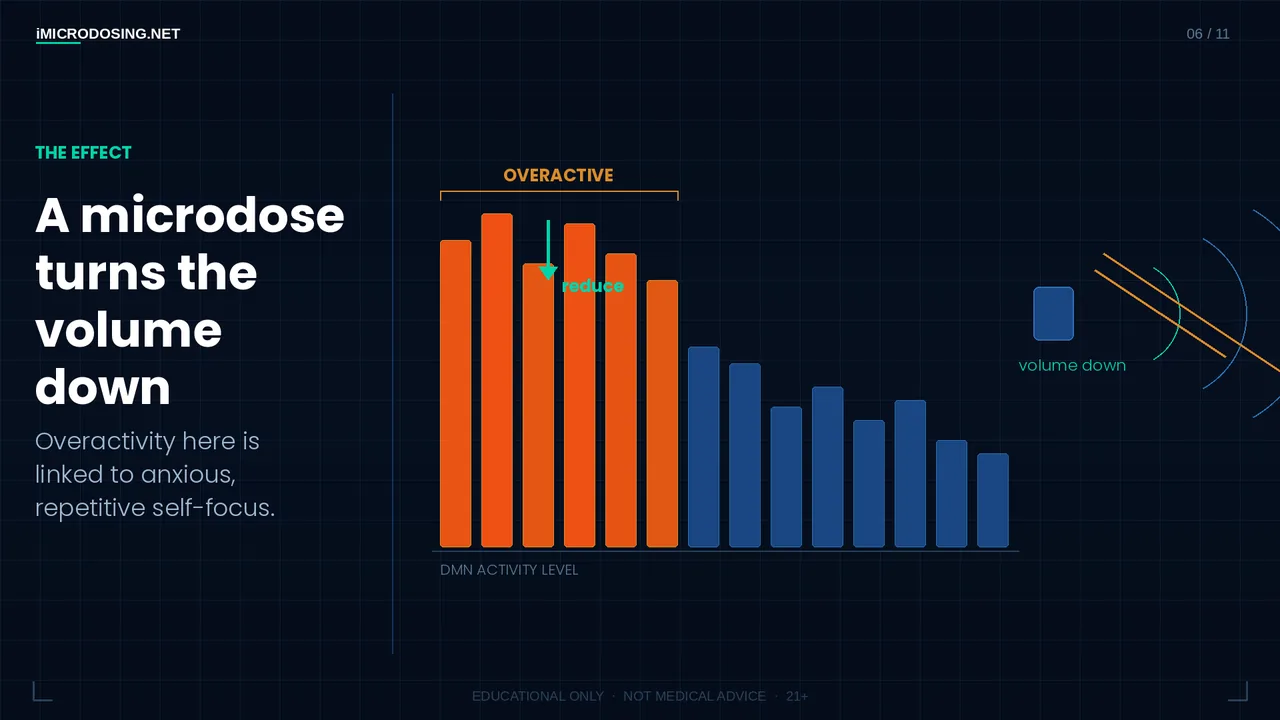
Episode 2, scene 06: What the research describes about that network SCENE 06
What the research describes about that network

Academic literature documents that when the Default Mode Network is persistently overactive, it correlates with patterns of anxious and repetitive self-focused cognition. Published research examines how psilocin interacts with this network.
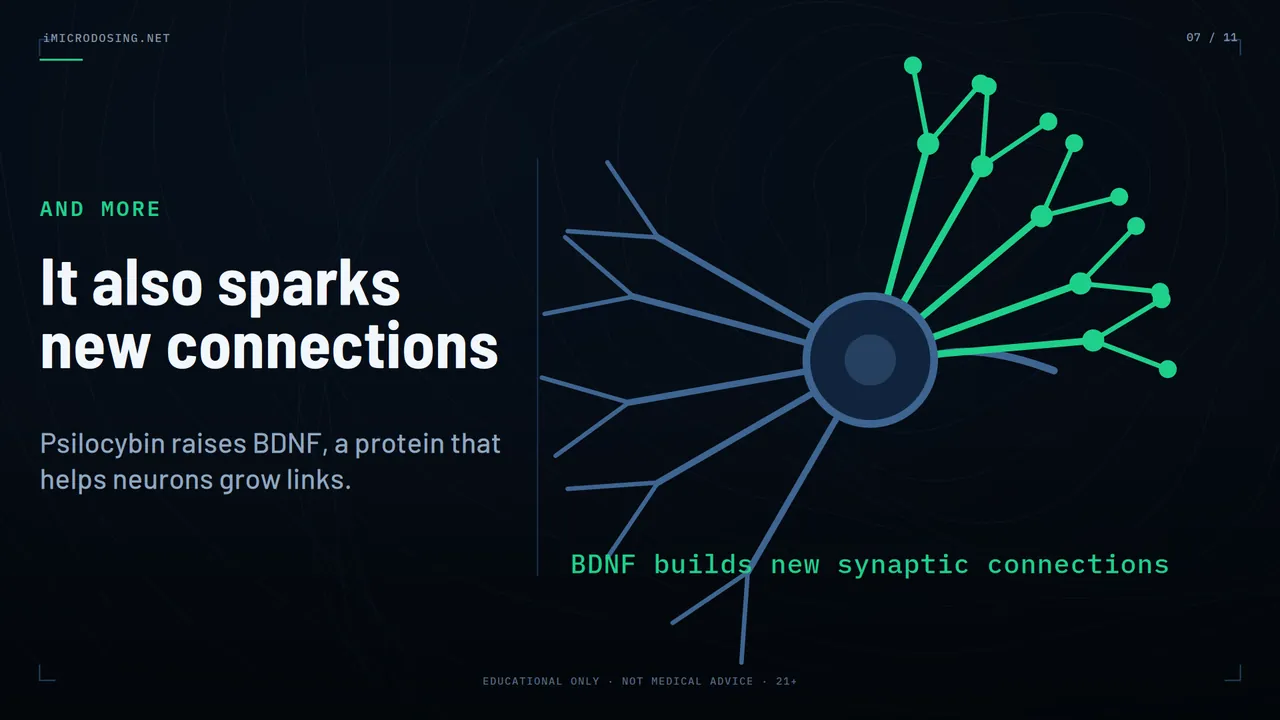
Episode 2, scene 07: BDNF — the brain's connection-building protein SCENE 07
BDNF — the brain's connection-building protein

Published research documents that psilocybin administration is associated with increases in BDNF — Brain-Derived Neurotrophic Factor — a protein that supports the formation of new neural connections.

Episode 2, scene 08: What neuroplasticity means in this context SCENE 08
What neuroplasticity means in this context

Neuroplasticity — the brain's capacity to form new connections — is the central theoretical framework in the published psychedelic research literature for understanding reported lasting effects.
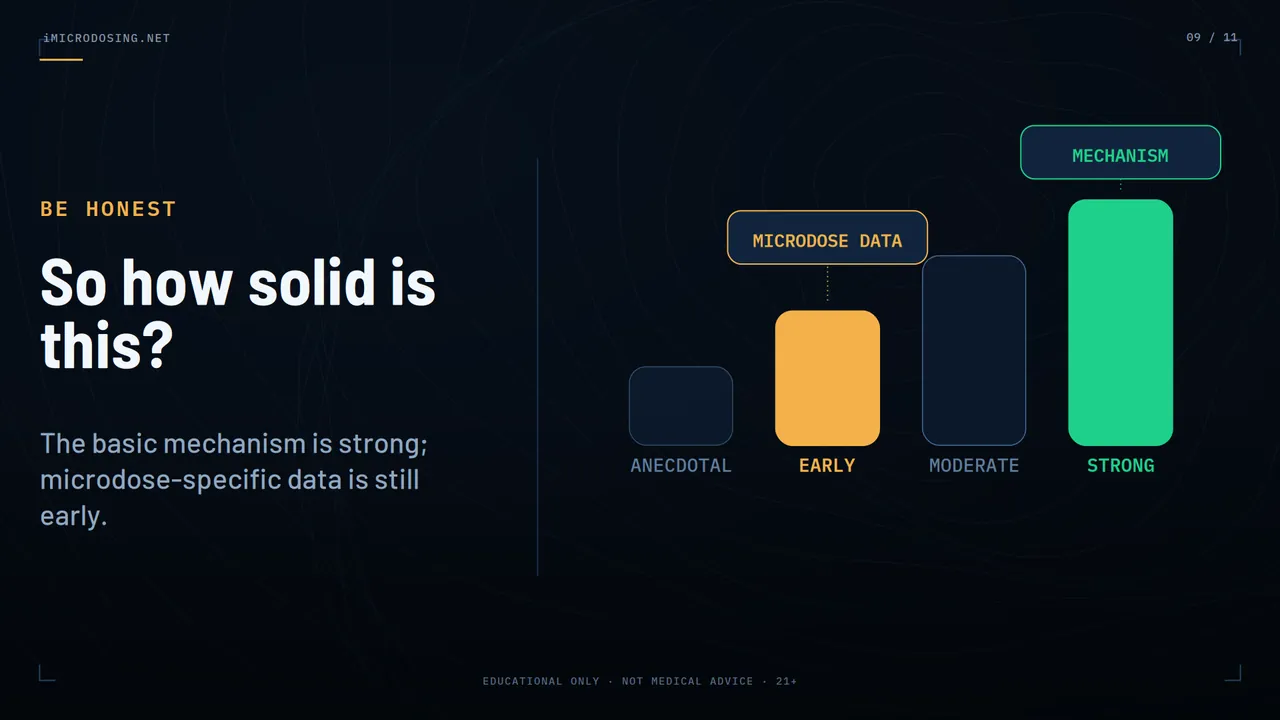
Episode 2, scene 09: How strong is the published evidence? SCENE 09
How strong is the published evidence?

Published research acknowledges that the basic receptor mechanism is well established in the literature. Broader questions remain the subject of active academic investigation across major research institutions.
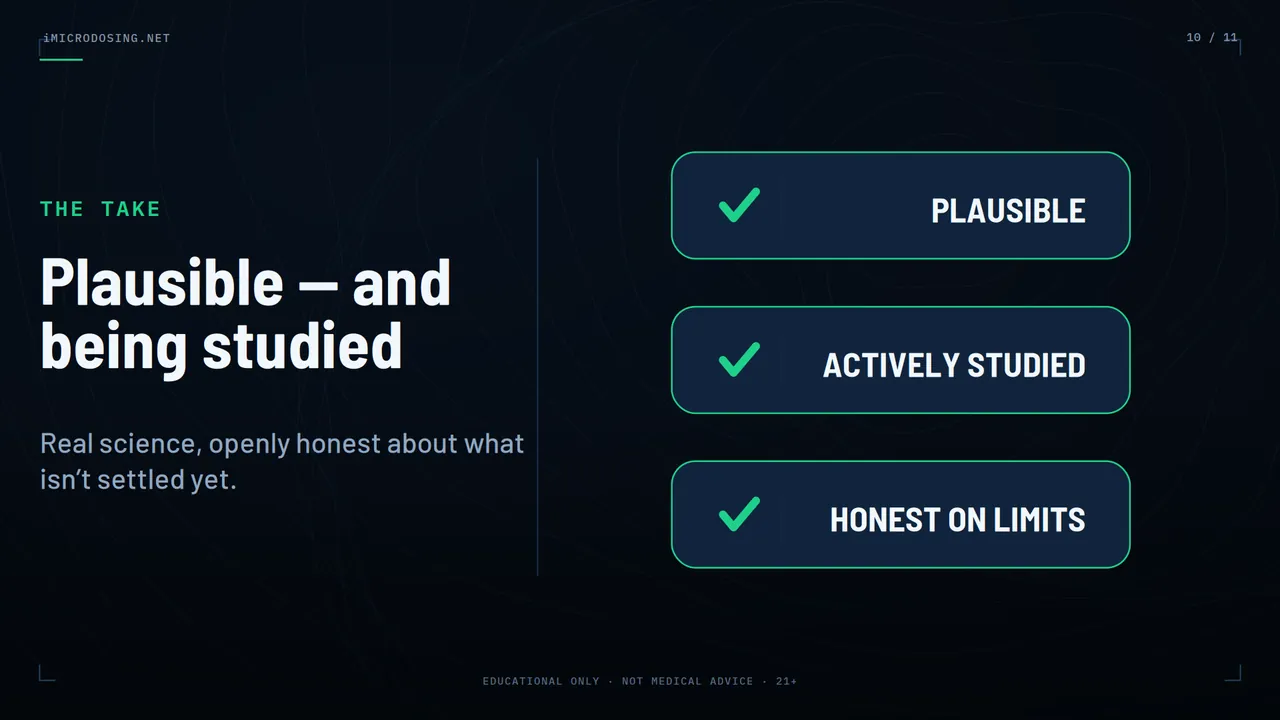
Episode 2, scene 10: Plausible science, actively studied SCENE 10
Plausible science, actively studied

The academic literature characterizes the science as theoretically plausible and the subject of ongoing peer-reviewed investigation at institutions including Johns Hopkins, Yale, Harvard, and McLean Hospital.
Episode 2, scene 11: Educational information only · 21+ SCENE 11
Educational information only · 21+

This content summarizes published academic research. It is not medical advice. For adults 21 and over.

Peer-reviewed research summary

What the published literature reports

A neutral summary of published, peer-reviewed findings. All statistics describe outcomes observed in supervised research or clinical trial settings — not outcomes for any personal practice.

All findings apply exclusively to supervised laboratory and clinical research contexts. No inference about personal use should be drawn.
1
Harvard Psilocybin Project & Good Friday Experiment — 1960–1962
Harvard University and Boston University, Cambridge/Boston. Among the first formal academic investigations of psilocybin in the United States. The 1962 Marsh Chapel double-blind study remains one of the most cited early studies in the published psychedelic literature. All research conducted in supervised institutional settings.
Foundational research — Boston
2
Structural neural changes observed with psilocybin — Shao et al., Yale University
Neuron, 2021. Researchers observed changes in dendritic spine density in the prefrontal cortex within 24 hours of psilocybin administration in a controlled preclinical research setting. Findings persisted through the documented follow-up period.
Preclinical research — Yale
3
FDA Breakthrough Therapy Designation for psilocybin
Granted in 2018 and 2019 for separate indications. Designed to expedite development of drugs showing substantial preliminary improvement over existing therapies in clinical trials. Not an approval — does not indicate commercial availability.
Regulatory designation
4
Johns Hopkins MDD trial — Davis et al., 2020
JAMA Psychiatry, 2020. A double-blind randomized controlled trial in a supervised clinical setting with trained clinical support. Response outcomes documented at 4-week follow-up. The controlled conditions of this trial are not replicated in personal use contexts.
Controlled trial — JHU
5
McLean Hospital / Harvard Medical School — ongoing research
McLean Hospital (Belmont, MA) — Harvard Medical School affiliate — is among the most active psychedelic research sites on the East Coast. Published findings on supervised psilocybin administration appear across multiple peer-reviewed journals. All research conducted under DEA Schedule I research licenses.
Active research — Boston
6
Massachusetts legal status — no statewide decriminalization
Massachusetts has not enacted statewide psilocybin decriminalization as of 2026. Cambridge and Somerville adopted local enforcement-deprioritization resolutions in 2021. Northampton also adopted a similar resolution. Boston proper has not. Psilocybin remains Schedule I federally and controlled under Massachusetts state law outside approved research settings.
Massachusetts legal status
Boston research at a glance

From 1960 to present — unbroken academic record

Harvard, 1960–1962

First formal US academic psilocybin research — Cambridge, Massachusetts

BU Marsh Chapel, 1962

First double-blind psilocybin study in American academic history

McLean Hospital, 2020s

Active Harvard-affiliated clinical research — most active East Coast site
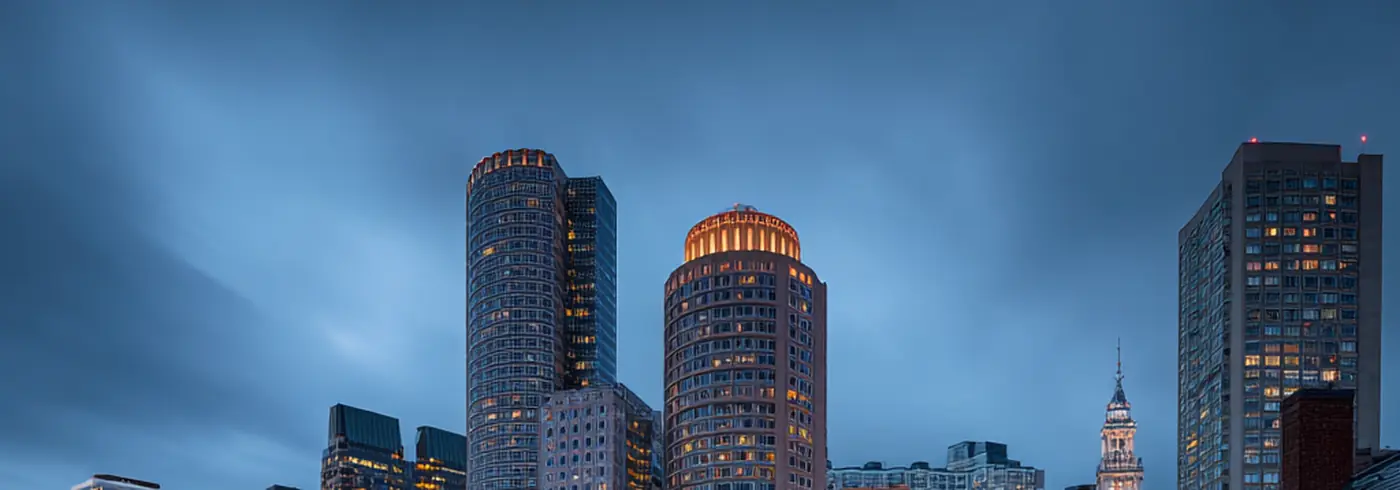
Kendall Square biotech

Multiple companies with Boston-area presence in active clinical development programs

Reporting note. Specific numerical outcomes from trials are not cited here as benefit claims. They are findings from controlled research contexts not replicated in personal use. See original published papers for full methodology.
Greater Boston

Boston’s neighborhoods and the research ecosystem

The research literature and its legal context intersect differently across Greater Boston’s neighborhoods — from Harvard Square’s academic core to Somerville’s local deprioritization to the Longwood Medical Area’s active research cluster.

Cambridge — Harvard Square
Local deprioritization · 2021
Home of Harvard University and MIT. The original site of American academic psilocybin research. Cambridge adopted a local enforcement-deprioritization resolution in 2021.
Somerville
Local deprioritization · 2021
Progressive, academic-adjacent community. Adopted enforcement deprioritization in 2021. Home to significant academic and creative-professional population.
Fenway — Longwood Medical Area
Active research cluster
McLean Hospital (Belmont, adjacent), Brigham and Women’s, Beth Israel Deaconess, Dana-Farber, and Children’s Hospital form one of the world’s densest medical research concentrations.
Beacon Hill & Back Bay
Boston proper · state law applies
Historic, institutional, professional. State House and legal district. High-education demographic. Boston proper — no local deprioritization. Massachusetts state law applies.
Kendall Square
Biotech innovation hub
The world’s most concentrated biotech innovation district. Multiple companies with Boston-area presence are in active clinical development programs involving psilocybin compounds.
South End & Jamaica Plain
Boston proper · state law applies
Progressive, culturally engaged communities. High awareness of alternative medicine and wellness research. Boston proper neighborhoods — Massachusetts state law applies.
Cambridge — Kendall Square / MIT
Research & biotech
MIT’s Picower Institute for Learning and Memory publishes neuroscience research with direct relevance to neuroplasticity mechanisms described in the psychedelic literature.
Charlestown & North End
Boston proper · state law applies
Historic Boston neighborhoods with strong community identity. Adjacent to the Longwood and downtown research ecosystems. Massachusetts state law applies.
Boston-area research institutions

The academic ecosystem behind the published research

No metro area in the United States has a comparable concentration of research institutions contributing to the published psychedelic literature. The following institutions have published peer-reviewed findings or are affiliated with active research programs:
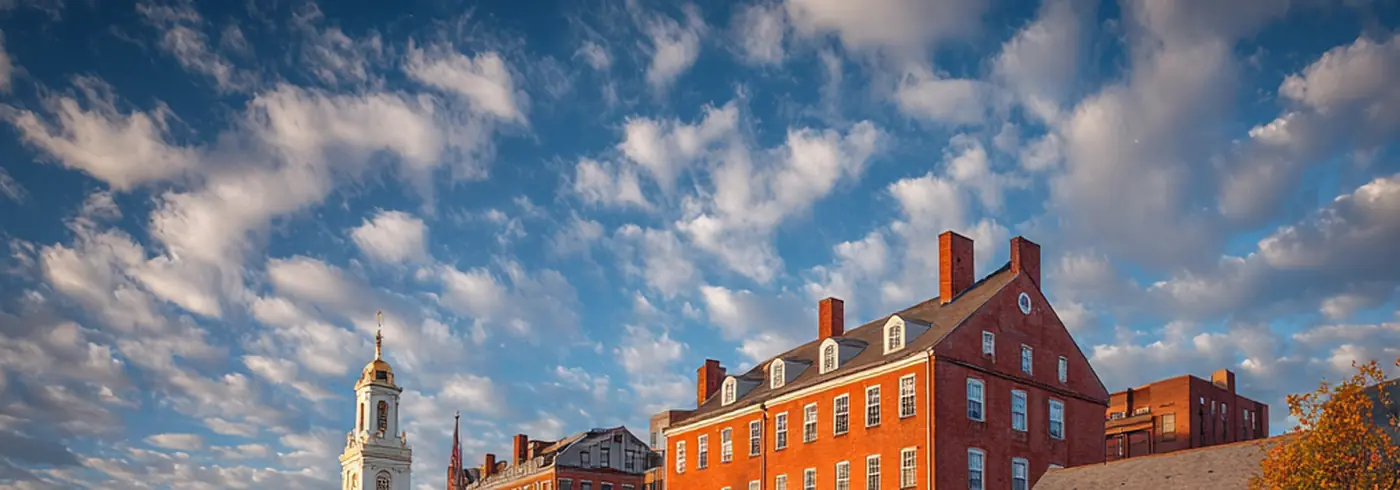
Affiliation note. References to research institutions are for educational context. They do not imply affiliation, endorsement, or partnership with JoinIMD Boston.
Harvard Medical School & McLean Hospital
The Harvard-McLean affiliation is the most directly relevant to this page. McLean Hospital (Belmont) is an active East Coast psychedelic research site. Published findings on supervised psilocybin administration appear across peer-reviewed journals.
Massachusetts General Hospital (MGH)
Harvard Medical School affiliate and part of Mass General Brigham. Treatment-resistant depression and neuroplasticity research programs with published findings relevant to the psychedelic literature.
Boston University — Marsh Chapel
Site of Walter Pahnke’s 1962 Good Friday Experiment — the first double-blind psilocybin study in American academic history. Historical significance unique to Boston in the published literature.
MIT — Picower Institute for Learning and Memory
Published neuroscience research on plasticity mechanisms, BDNF, and memory consolidation with intersection points to the psychedelic research literature.
Harvard University — original site
Where the Harvard Psilocybin Project (1960–1962) was conducted. The foundational research that established Boston as the birthplace of American academic psychedelic investigation.
Kendall Square biotech cluster
Multiple companies with Boston-area presence in active clinical development for psilocybin compounds, including COMPASS Pathways partnerships and smaller biotech programs operating under IND applications.
📍 Boston · Cambridge · Somerville · Greater Boston Metro

Want to go deeper into the published research?

This educational resource covers the peer-reviewed findings, Massachusetts legal context, and Boston’s unique research legacy.

This page and all linked resources are educational only. No commerce, no personal-use guidance, no medical or legal advice.

Or send a message with questions about the research.

Frequently asked questions

Questions about the research and legal status

Massachusetts’ legal context, Harvard’s research history, and the neuroscience of psilocybin — answered directly and accurately for a Greater Boston audience.

Editorial team

Contact the editorial team with research citation questions, corrections, or source suggestions.

Send a research question →
Massachusetts has not enacted statewide psilocybin decriminalization. Psilocybin remains a controlled substance under Massachusetts state law and Schedule I under federal law. Cambridge and Somerville adopted local enforcement-deprioritization resolutions in 2021. The city of Boston proper has not adopted such a resolution. Local resolutions do not override state or federal law. This page does not provide legal guidance. Consult a licensed Massachusetts attorney.
Cambridge and Somerville both adopted local enforcement-deprioritization resolutions in 2021. Northampton (western Massachusetts) also passed a similar resolution. Boston proper — including Beacon Hill, Back Bay, South End, Fenway, Charlestown, and North End — has not adopted a local deprioritization resolution. All of Massachusetts remains under state law, and all jurisdictions remain under federal Schedule I classification.
The Harvard Psilocybin Project (1960–1962) was one of the first formal academic investigations of psilocybin in the United States. Conducted at Harvard University by Timothy Leary and Richard Alpert (later Ram Dass), the project administered psilocybin in supervised settings and produced multiple published findings. The 1962 Good Friday Experiment at Boston University’s Marsh Chapel, connected to this research program, was the first double-blind psilocybin study in American academic history.
McLean Hospital in Belmont, MA — affiliated with Harvard Medical School — is among the most active psychedelic research sites on the East Coast. Published findings from McLean-affiliated researchers appear in peer-reviewed journals examining supervised psilocybin administration, depression, OCD, and neuroplasticity. All research is conducted under DEA Schedule I research licenses. These findings represent supervised clinical research and do not apply to personal use contexts.
Neuroplasticity is the brain’s capacity to reorganize itself by forming new neural connections throughout life. Published research has examined whether certain psychedelic compounds interact with neuroplastic mechanisms including dendritic spine density (Yale, Neuron, 2021), BDNF expression, and Default Mode Network modulation. These findings are from controlled laboratory and clinical research settings. Specific outcome figures should be read in the context of the full published papers and their methodology.
REBUS stands for Relaxed Beliefs Under Psychedelics. Published by Carhart-Harris and Friston in Pharmacological Reviews (2019). It proposes that psychedelic compounds temporarily reduce the dominance of top-down predictive brain signals, allowing more flexible information processing. This is a theoretical framework, not a clinical guideline or treatment protocol.
No. This page does not provide personal-use guidance, commercial guidance, instructions for use, or guidance on any specific quantity, format, or method of use. It is a neutral educational resource summarizing published peer-reviewed research and Massachusetts legal context. Nothing on this page constitutes medical, legal, personal-use, commercial, or use advice of any kind.
Editorial team

Contact the editorial team

Submit a research citation question, editorial correction, or source suggestion.

✔ Educational enquiries only ✔ Typical response: quick response during active hours ✔ No medical or legal guidance

Fields marked * are required. Educational enquiries only.

Scope note. We do not provide personal advice, personal-use guidance, or medical, legal, or commercial guidance. Messages outside this scope may not receive a reply.
Veteran-founded 2016 Harvard legacy · McLean Hospital BBB accredited — A- Educational only No commerce · No personal-use guidance · 21+
On this page